

Last Updated: November 1, 2026
Quick Summary
The cheapest way to build a capsule wardrobe is to shop your own closet first, sorting everything into keep, repair, and release piles before spending any money. Then fill only the gaps on your list, following a color palette and per-item price ceilings so every piece mixes and matches.
- Most capsule wardrobes land between 30 and 40 pieces for a full season, including shoes and accessories.
- A low-cost starter set of roughly 20 core pieces costs near $500-$700 new, or $250-$400 with half secondhand.
- If you can only buy five things, start with two plain tees, one neutral trouser, one dark denim, and one layer.
- Apply the 30-wear test and a seven-day waiting period before buying anything not on your gap list.
- Buy secondhand for outer layers, denim, and shoes, where new prices are highest and supply is widest.
Table of Contents
- Start With a Wardrobe Audit, Not a Shopping List
- How Many Clothes in a Capsule Wardrobe Actually Belong
- Choose a Personal Style and Color Palette Before You Buy
- Capsule Wardrobe Essentials That Earn Their Place
- Your Capsule Wardrobe Checklist for a Low-Cost Starter Set
- A Realistic Budget and Cost-Per-Wear Math
- Where to Shop Secondhand Without Getting Burned
- Capsule Wardrobe Outfit Ideas That Mix and Match
- Care, Repair, and Making Cheap Pieces Last
- Build Your Capsule With Dapper321 Pieces You'll Actually Rewear
- Frequently Asked Questions
Start With a Wardrobe Audit, Not a Shopping List
Learning how to build a capsule wardrobe cheaply starts with subtraction, not addition. A capsule wardrobe is a small, curated collection of clothing that mixes and matches to create many outfits, and the cheapest way to build one is to shop your own closet first. In most budget wardrobes, the pieces are already there, just buried. Before you spend a single dollar, spend an afternoon taking inventory.
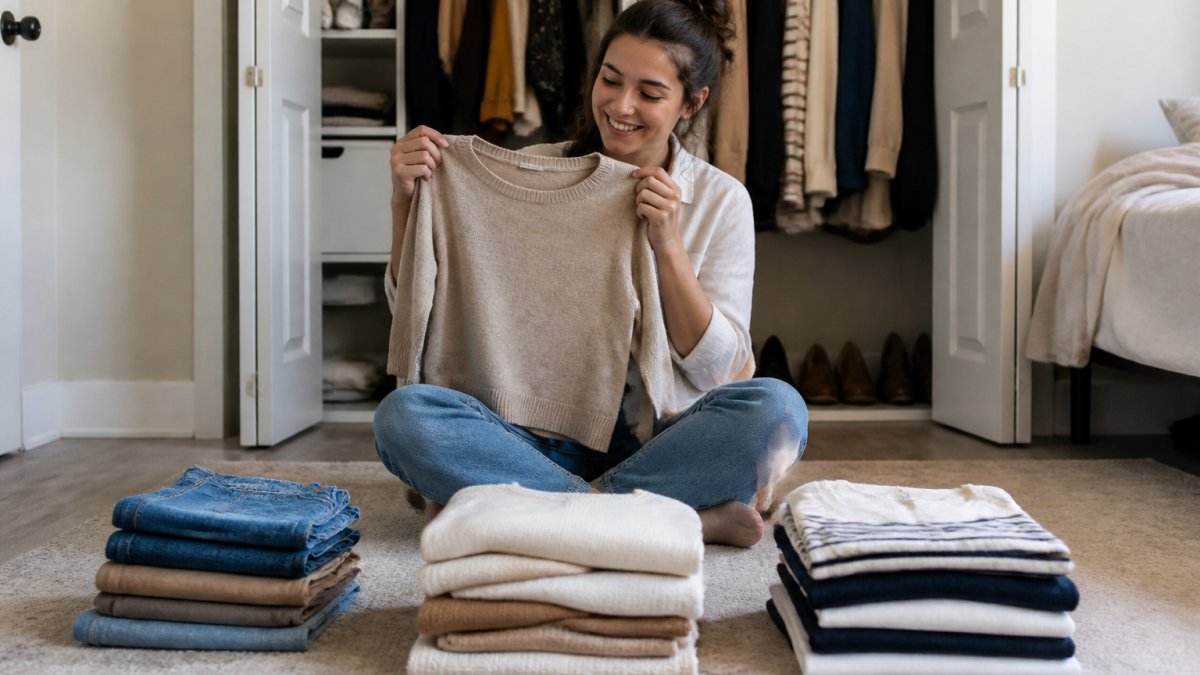
The Three-Pile Closet Cleanout
Pull everything out and sort it into three piles: keep, repair, and release. The keep pile holds only items that fit well today, suit your actual life, and pair with at least two other pieces. The repair pile gets a button, a hem, or a stain treatment. The release pile is everything else. Be honest here. A common mistake is keeping clothes for a version of your life you don't actually live, like occasion wear for events that rarely happen.
Spotting Your Wardrobe Gaps
Once the keep pile is back in the closet, look for holes. Gaps show up as missing basics: no plain tee that works under a blazer, no neutral trouser, no layer for cool evenings. Write these down. That list becomes your shopping list, and it keeps you from buying a fifth black top when you own zero pairs of well-fitted trousers.
How Many Clothes in a Capsule Wardrobe Actually Belong
Most capsule wardrobes land between 30 and 40 pieces for a full season, including tops, bottoms, layers, one dress, shoes, and accessories. That number is a guide, not a rule. A work-from-home wardrobe needs fewer structured pieces; a corporate job needs more. The real test is versatility, not a headcount. If every top works with every bottom, 30 pieces can generate well over a hundred outfit combinations. If they don't, 60 pieces won't help.
Choose a Personal Style and Color Palette Before You Buy
Budget wardrobes fall apart when pieces don't talk to each other. Pick a color palette first: two or three neutral colors plus two accent colors you genuinely love wearing. Neutral colors like black, navy, cream, gray, and olive do the heavy lifting; a statement piece in an accent color adds personality without breaking the system. Then define your personal style in a sentence. "Relaxed casual with clean lines" or "polished but comfortable" gives you a filter for every purchase. If a piece doesn't fit the sentence or the palette, it doesn't come home, no matter how good the sale is.
Capsule Wardrobe Essentials That Earn Their Place
Capsule wardrobe essentials are the pieces you reach for weekly, not the ones that look good on a hanger. A plain cotton tee, a well-fitted neutral trouser, a layer for temperature swings, one dress that works day-to-night, and comfortable shoes cover most of daily life. Quality over quantity matters more than brand names. Check seams, fabric weight, and how the piece washes before you commit.
Tops, Bottoms, and the One Dress That Does Everything
For tops, a No Rules - Essential Cotton T-Shirt in a neutral shade anchors everything from jeans to tailored trousers. Add a layer like the BTO - Beat The Odds Boxy Fit Fleece Hoodie for cooler days, and you've covered casual, office-casual, and weekend in two pieces. For bottoms, one neutral trouser and one dark denim cover most occasions. The dress should work with sneakers by day and heels by night; that single piece replaces three.

Your Capsule Wardrobe Checklist for a Low-Cost Starter Set
A complete low-cost starter checklist keeps you from overbuying, and the difference between a checklist that works and one that becomes a shopping list is specificity. The table below gives suggested quantities for a first capsule, realistic per-item price ceilings for a budget build, and a note on what each piece actually does in the rotation. Treat the price ceilings as guardrails, not targets: they are the upper end of what most budget shoppers should pay for a piece that will survive a year of regular wear.
| Category | Quantity | Budget price ceiling per item | What it does in the rotation |
|---|---|---|---|
| Plain tees | 4 | $15-$25 | Base layer under blazers, cardigans, and shackets |
| Button-down or blouse | 1 | $25-$40 | Works alone or under a knit; dresses up denim |
| Knit sweater or hoodie | 2 | $25-$45 | One neutral, one accent; handles temperature swings |
| Neutral trousers | 2 | $30-$50 | One tailored, one relaxed; replaces jeans at the office |
| Dark denim | 1 | $30-$60 | Straight or bootcut; the casual workhorse |
| Dress | 1 | $30-$50 | Day-to-night versatility; replaces three outfits |
| Outer layer | 1 | $40-$80 | Jacket or blazer; the piece that finishes an outfit |
| Shoes | 3 | $30-$70 | Sneakers, flats, one heel or boot |
| Accessories | 3-5 | $10-$30 | Bag, belt, scarf, jewelry; stretches the palette |
That is roughly 20 core pieces before accessories, and at the middle of those ranges the full starter set lands near $500-$700 if you buy everything new. Most people do not need to spend that in one pass. A staged build, tees and trousers first, then the layer and dress, then shoes and accessories, spreads the cost across two or three months and lets you test what you actually rewear before adding more.
What to Buy First When the Budget Is Tight
If you can only buy five things this month, buy the pieces that unlock the most combinations: two plain tees, one neutral trouser, one dark denim, and one layer. You can find a Unisex Regular Fit Cotton T Shirt to tick off a core item on the checklist. Those five pieces alone generate more than a dozen outfits and cover most casual and office-casual days. Add the dress and button-down in month two, then shoes and accessories in month three. This order matters because it front-loads versatility, the opposite of buying a statement piece first and discovering you have nothing to wear it with.
How to Adapt the Counts to Your Life
The quantities above assume a mixed casual and office-casual week. Adjust them, not the structure:
- Work-from-home or caregiving: drop the tailored trouser and heel; add a second relaxed bottom and a second knit. Total stays near 18 pieces.
- Corporate dress code: add one blazer and one extra button-down; keep the dress. Total rises to about 23 pieces.
- Warm climate year-round: cut the outer layer and one knit; add a second dress and a short-sleeve button-down. Total stays near 19 pieces.
- Cold climate: keep both knits and the outer layer; add a second outer layer (a heavier coat) and swap one tee for a long-sleeve. Total rises to about 22 pieces.
The point of the checklist is not the headcount. It is that every line item has a job, a price ceiling, and a place in the build order, so you can start from zero without treating the guide as a shopping spree.
A Realistic Budget and Cost-Per-Wear Math
Cost per wear is the number that matters, and the formula is simple: divide the price by the number of times you will wear it. The hard part is estimating wears honestly. A common pattern among budget shoppers is to overestimate how often a trend piece will leave the closet and underestimate how often a plain tee gets reworn. The table below shows the math across categories using realistic wear counts for a one-year window.
| Piece | Price | Estimated wears in year one | Cost per wear |
|---|---|---|---|
| Plain cotton tee | $20 | 100 (twice a week) | $0.20 |
| Neutral trouser | $45 | 80 (office days) | $0.56 |
| Dark denim | $50 | 60 | $0.83 |
| Knit sweater | $35 | 40 (cool months) | $0.88 |
| Day-to-night dress | $45 | 30 | $1.50 |
| Trend top | $15 | 3 | $5.00 |
| Statement heel | $60 | 6 | $10.00 |
The cheaper item was the expensive one. A $15 trend top worn three times costs more per wear than a $45 dress worn thirty times, and the gap widens in year two when the tee and trouser are still in rotation and the trend piece is gone. This is the mechanism that makes a cheap capsule actually cheap over time: you are not optimizing for the lowest sticker price, you are optimizing for the lowest cost per wear across the pieces you rewear.
Setting a Realistic Total Budget
A first capsule built from the starter checklist typically lands between $500 and $700 when bought new at mid-range budget prices, and between $250 and $400 when half the pieces come from secondhand or resale. That range assumes you are replacing gaps, not rebuilding a full closet. If you already own wearable tees, denim, or a coat, subtract those lines from the total before you set your number.
No Rules – Essential Cotton T-Shirt →
A workable monthly budget for most people is one-third of the total per month across three months. That pacing does two things: it prevents a single large purchase that you regret, and it gives you a month of wearing the first pieces before you commit to the next batch. If a piece underperforms in month one, you can adjust the plan before spending the rest.
The 30-Wear Rule and the Waiting Period
Before any non-essential purchase, apply two filters:
- The 30-wear test. Can you honestly see yourself wearing this 30 times in the next year? If not, the cost per wear is likely above $1, and it probably does not belong in a budget capsule.
- The waiting period. For anything that is not on your gap list, wait seven days before buying. Most impulse purchases do not survive the week. The ones that do are usually filling a real gap.
Neither filter requires an app or a spreadsheet. A note on your phone with the gap list and the date you first wanted an item is enough.
Where Budget Shoppers Actually Save
The savings in a cheap capsule come from three places, in order of impact:
- Rewearing what you own. The audit in the first section is the single biggest cost saver because it converts existing clothes into capsule pieces.
- Buying secondhand for the highest-price lines. Outer layers, denim, and shoes have the widest secondhand supply and the highest new prices, so the savings per purchase are largest there.
- Choosing fabric weight over brand. A heavier cotton tee at $20 often outlasts a thin $12 tee by a full year, which lowers cost per wear even though the sticker is higher.
Where to Shop Secondhand Without Getting Burned
Secondhand and thrift shopping stretch a budget further than anything else, but they come with traps. Check for stretched seams, pilling, missing buttons, and odors before buying. Try things on when you can; sizing varies wildly across brands and decades. Online resale adds risk, so ask sellers for measurements, not just the listed size, and read return policies carefully. A good rule: only buy secondhand pieces that fill a gap on your list. Otherwise, the low price becomes an excuse to add clutter.
Capsule Wardrobe Outfit Ideas That Mix and Match
Capsule wardrobe outfit ideas come from formulas, not inspiration boards. Try these combinations:
- Tee + tailored trouser + blazer for office days
- Hoodie + fleeced jogger sweatpants + sneakers for errands
- Button-down + dark denim + flats for lunch plans
- Dress + knit layer + boots for cooler evenings
- Tee + flared sweatpants + a structured bag for a casual night out
Each formula uses pieces from your checklist, which is the whole point: a small wardrobe creates many outfit combinations because everything works together.


Care, Repair, and Making Cheap Pieces Last
Affordable clothing lasts when you treat it well. Wash on a gentle cycle, turn prints inside out, and skip the dryer when you can; heat is what shrinks and fades fabric. Learn two repairs: replacing a button and stitching a hem. Both take minutes and save pieces from the release pile. Store knits folded rather than hung to avoid shoulder stretch. Watch out: ignoring care labels on cotton and fleece blends is how a cheap capsule becomes a disposable one.
Build Your Capsule With Dapper321 Pieces You'll Actually Rewear
The hardest part of a capsule wardrobe isn't the list, it's finding affordable pieces that hold up and actually match each other. That's where we come in. Dapper321 offers trendy, affordable apparel and accessories so you can fill your wardrobe gaps without designer price tags, and our BTO collection adds a layer of meaning to everyday pieces.
Ready to stop overbuying and start dressing with intention? Shop Dapper321 and build a capsule wardrobe that feels put together every single day.
Frequently Asked Questions
How do you start a capsule wardrobe on a budget?
Begin with what you already own. Pull everything out, sort it into keep, donate, and repair piles, then write down the gaps you keep running into, like a missing neutral layer or a pair of trousers that actually fit. Shop those gaps only, set a dollar cap per item, and check secondhand listings first. Buying five to eight well-chosen pieces over a couple of months costs far less than a single panic shopping spree.
How many pieces should a capsule wardrobe have?
Most workable capsule wardrobes land between 25 and 40 pieces, counting tops, bottoms, dresses, outerwear, and shoes but not accessories or workout gear. A tighter 25-piece capsule suits warm climates or people who dress casually most days. If you work in an office or live somewhere with four real seasons, lean toward 35 to 40 so you can cover layering, occasion wear, and a seasonal swap without repeating the same outfit twice a week.
What are the essential pieces for a budget capsule wardrobe?
Start with two or three neutral tops, one white or cream tee, one pair of well-fitted dark trousers, one pair of jeans, one dress that works day to night, one knit layer, one structured jacket, and one pair of shoes you can walk in all day. Add a cotton tee like the No Rules Essential Cotton T-Shirt as a reliable base layer, then build outward. Neutral colors keep every piece compatible, so you need fewer items to create more outfits.
How much does it cost to build a capsule wardrobe?
A realistic low-cost build runs roughly $250 to $600 if you shop secondhand and sales, spread over two or three months. A 30-piece capsule averaging $20 per piece lands near $600; mixing in thrifted finds at $8 to $15 drops it closer to $300. Track cost per wear instead of sticker price: a $26.83 tee worn 40 times costs about $0.67 per wear.
How can you build a capsule wardrobe using clothes you already own?
Do a full closet cleanout first and be honest about fit. Keep only pieces that fit now, feel comfortable, and match at least three other items you own. Photograph your best existing outfit combinations so you remember them. Most people find they already own 60 to 70 percent of a capsule and only need a handful of gap-filling pieces, which cuts the cost dramatically and avoids buying duplicates you will never wear.
Where can you find affordable capsule wardrobe basics?
Thrift stores, consignment shops, online resale platforms, and end-of-season sales cover most budget needs. Check seams, zippers, and fabric weight before buying secondhand, and confirm return policies on resale apps since many are final sale. Boutique options like Dapper321 offer affordable new pieces, such as the No Rules - Essential Cotton T-Shirt at $26.83, so you can fill gaps with new items without designer pricing.
